Baby Won't Make Suction on Bottle or Nipple
When your breastfed baby won't have a canteen, it tin be stressful and even a fiddling scary. Babies are not always onboard when transitioning from breast to canteen. Whether you're going back to piece of work or want others to help feed your infant, you lot might beginning to wonder: "What if my baby never takes a canteen?"
Don't panic. Commonly when your baby won't take a canteen, they're just struggling with the learning curve. They're new to the earth so they have a lot to learn. Sometimes at that place may be some motor skill or medical condition making it more difficult. But no thing the reason, we're here to help.
Keep reading to learn the most common reasons why your babe may be refusing a bottle, tips for helping them get used to a bottle, and what may be going on if canteen feeding doesn't start to ameliorate.
Not all bottle refusal looks the same. In that location can be a range of signs that your child is struggling to have a bottle, including:
- Turning abroad from the bottle
- Gagging or fussing as the bottle's nipple nears their mouth
- Being unable to latch/compress the bottle's nipple and express milk
- Chewing on the bottle's nipple
- Sputtering or cough while feeding
- Not being able to completely eat their sip of milk, and then that some drips from their mouth
Why do many babies have bug when switching to a bottle subsequently breastfeeding?
In that location's no one-size-fits-all respond to this question. In most cases, bottle feeding problems aren't due to aberrant oral motor function, nor are they ordinarily due to an underlying medical issue.
Really, 1 of the most common reasons breastfed babies won't take a bottle right abroad stems from non being introduced to one early enough in their growth. In fact, the number i mistake families make is offer a bottle too late.
Why timing is so important when introducing a bottle to a breastfed baby
Babies are born with an automated sucking reflex. But at 2 to 3 months onetime that reflex becomes voluntary. In effect, that gives babies the ability to plough down a feeding if they're not comfortable with it.
If a baby hits this stage in their growth and has just fed from their mother'due south chest, they may accept developed a "preference" for that method of milk delivery. Babies institute a suck-eat-breathe design that works for them and lets them handle their female parent's milk menstruation.
When given a canteen, not only is the milk flow different, a infant has to adapt to a different nipple shape and texture. They also need to slightly conform their posture from what they're used to. For someone so new to the world, making these kinds of changes tin exist difficult and overwhelming, leading to fussing, tears and why your breastfed infant won't take a bottle.
When to introduce a bottle to a breastfed baby
There'south an platonic window of time for introducing a bottle to a breastfed infant. You want to avoid doing it likewise late, but you also don't want to exercise it too early. It's important to make certain your baby gets the hang of breastfeeding and is getting plenty milk before introducing a canteen.
We usually recommend waiting about 2 to four weeks afterward your baby is born earlier trying to bottle feed. Unless they were born early, most babies are ready by so.
How to become a breastfed baby to have a bottle: five helpful tips
1. Switch back and forth between breastfeeding and bottle feeding
You requite your baby the best chance at developing their feeding skills if y'all regularly switch between bottle and breast in the midst of feedings.
two. Try giving the bottle when your baby is waking up
No matter the time of day, babies are more than likely to accept a canteen when they're simply waking upward. The instinct to eat takes over when babies are withal a little sleepy. Don't let your baby go overly hungry earlier feeding. That tin can result in fussiness and crying (a late feeding cue), and make it harder to initiate feeding either by bottle or breast.
3. Create a relaxing environment each time you offer the bottle
Play soft, calming music – like classical or folk. Sit downwards someplace where you can gently rock back and forth. And swaddle your babe with their easily near their face. Having a placidity, dark room with few distractions tin can help, also.
Doing these things will relax your infant – in part because they will as well relax yous. Children sense and feed off the energy of the adults effectually them. And it'southward no different when you lot and your baby are adjusting to bottle feeding. If yous can be at ease with the varied routine a bottle brings, your infant will be more content, too.
4. Have a family unit member other than mom offer the bottle whenever possible
Each person will hold your baby a footling bit differently for feedings. When your little one can go used to these differences early, it helps them learn how to adjust their posture so it'due south less likely to be an issue when their sucking reflex becomes voluntary.
5. Endeavour giving your babe a different blazon of bottle or nipple
Sometimes, the solution to bottle feeding problems is equally simple every bit finding the right canteen or nipple. While in that location are nipple levels associated with historic period, every baby has their ain feeding style, which may not match their historic period or size. There are many dissimilar nipple and bottle types out in that location – trying to figure out the best choice can be an overwhelming process. Finding the right fit is something that your baby's doctor or a lactation specialist can help you lot with.
vi. Experiment with infant'south bottle-feeding position
Your infant may besides adopt to eat while in a certain position, which typically differs from breastfeeding positions. Try different angles and placements to see if in that location is one they favor. For example:
- Cradling them in your arm at a 45-degree angle while keeping their head and neck aligned.
- Sitting upright so that their back is confronting your stomach.
- While sitting or lying downwardly, bend your legs and position your baby then they face yous with their head resting against your knees, their dorsum against your thighs and their feet on your breadbasket.
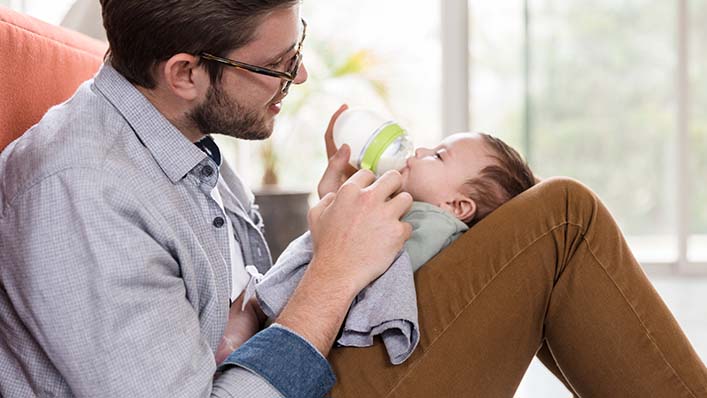
No matter what position you use, think to angle the canteen and so that milk only comes out when your baby sucks, and never prop the bottle in their oral fissure. Besides remember to never lay your baby completely flat while feeding.
What to do when an older baby is refusing to take a bottle
The breast to bottle transition is certainly easier if you innovate a bottle at the correct age. But even if your baby is already 2 to 3 months onetime, it'due south notwithstanding possible. In addition to the tips above, you can aid your baby do with a pacifier.
A pacifier can help babies class and strengthen their sucking ability. Consistently offer a pacifier to aid soothe your infant when they're fussy, if you're non already. This helps your infant learn to organize their oral fissure movement, which will at-home them. Once that becomes routine, begin offering your baby a pacifier for 20 to xxx seconds when you go to make a bottle. Doing then will help them more calmly gear up for bottle feeding.
Gently pull on the pacifier as your infant sucks it. Make certain to do this at least 3 to five times a day, including when your babe is using the pacifier to prep for a bottle feeding. These slight tugs will aid your babe learn how to resist releasing the seal they've formed on the pacifier'due south nipple. And that can strengthen their latch on a bottle'due south nipple, too.
When the above tips don't piece of work, at that place may exist another reason your baby is refusing a bottle
If you've been trying at-home strategies for a few days and your baby doesn't seem to be getting more comfortable taking a bottle, call your babe's doctor. They tin can assistance determine whether a medical effect may exist nowadays or connect you with a specialist if needed. Other reasons why your infant is refusing a bottle can include:
Reflux issues can cause pain with eating
Babies tin get heartburn, too! When a baby has reflux, nutrient and stomach acrid flow from the tum back into the esophagus (the tube the carries nutrient from the mouth into the stomach).
Reflux causes babies to feel discomfort or pain when eating, which understandably affects feeding. Symptoms that may signal to reflux issues include:
- Arching or stiffening their back when feeding
- Crying, fussing and getting red or watery eyes while feeding
- Coughing regularly during feedings or right after them
- Refusing to drink or accepting only 1 ounce of milk or less
- Falling comatose while feeding
- Having poor sucking and breathing coordination
- Taking a long time to consume or drinkable
It's important to know these actions tin occur and not be related to reflux. It'due south common for babies to have a fussy time of twenty-four hours or be more tired some days than others. If symptoms are ongoing, a babe can be evaluated and treated for reflux.
Facial or oral structural differences tin can brand latching hard
If reflux doesn't appear to be the problem, your baby'south md may refer y'all to a rehab specialist like me.
I've been helping moms and families who struggle with the transition to bottles for almost a decade. It'south function of my work as a oral communication therapist at Park Nicollet. You might retrieve, "My baby's trouble is with eating – not talking. What does speech therapy have to practise with that?" The answer could be, a lot!
The shape or structure of a babe's cheeks, mouth, natural language or jaw tin can impact their feedings. That's because these trunk parts touch how they're able to latch both to the canteen, as well as to the breast. For example:
- Sparse cheeks with piffling to no fat pads brand it hard for a baby to hold their tongue in place to feed
- A tongue-tie(where the tissue that attaches the tongue to the lesser of the mouth is likewise short) tin limit a baby's ability to move their tongue from side to side in their mouth or by their lower lip to feed
- A tongue-tie that'southward been clipped requires a baby to relearn how and where to move their tongue to feed, and create new musculus memory
- A "vaulted" palate (where the roof of the oral fissure is higher and narrower than the typical apartment U-shape) causes boosted space in a infant's oral cavity that tin can make it harder for their lips to class a tight seal
Weak oral muscle tone or lack of oral stimulation can make it hard to get enough milk during feeding
It's possible that a baby just doesn't accept the strength to get what they demand during a feeding. This could exist the example even if they have very normal oral motor actions.
If your baby is refusing to take a canteen, we're just a phone phone call away
Always feel empowered to phone call your infant's md or brand an appointment with them. They can connect you with different types of breastfeeding back up, including driblet-in breastfeeding support groups and lactation consultants who assist with both bottle and breastfeeding bug. They tin can besides refer you to a pediatric rehabilitation specialist.
Our incredible nursing staff is also here for you. HealthPartners patients tin can call 800-551-0859. Park Nicollet patients can call their clinic directly during regular business hours, or 952-993-4665 if it's afterwards hours. For questions and advice on new baby care, you can also call our 24/vii BabyLine at 612-333-2229.
Find a doctor who can assistance
Are you still looking for the right doctor for your new infant? We have hundreds of doctors and clinicians across the Twin Cities, central Minnesota and western Wisconsin, that tin assist you with all your questions.
While you may be wondering how to get them to take a bottle today, you'll get it figured out. Then the question will be: How can I get my child to swallow their vegetables?
Source: https://www.healthpartners.com/blog/baby-wont-take-bottle-help/

Post a Comment for "Baby Won't Make Suction on Bottle or Nipple"